11 The “Holy Trinity” Church
At 9 Ioan Maiorescu Street, just a few steps from the “Carol I” National High School and the Otetelișanu School, stands one of the oldest aristocratic churches in Craiova.
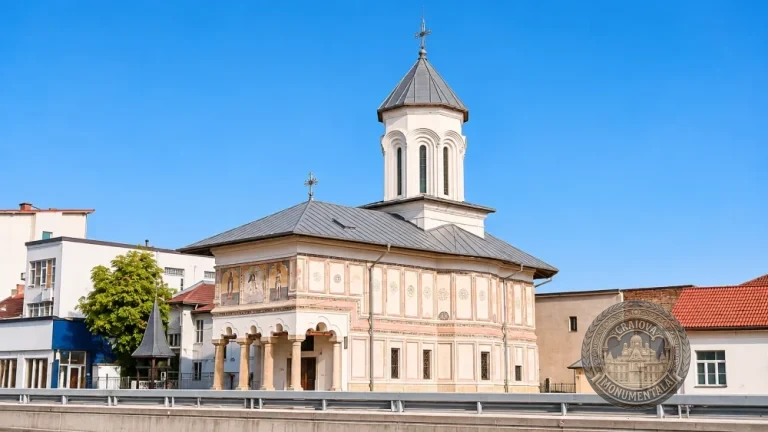
The “Holy Trinity” complex comprises the church itself and the entrance tower.
The story of this church has a heroine.
The church—formerly known as “Sfânta Troiță” or “Știrbei Church”—was founded by the elderly lady Dumitrana Știrbei, the steward’s wife, known as Știrboaica, daughter of the scholar Constantin Strâmbeanu and widow of Grand Logothete Constantin Știrbei, who had served as caimacam of Craiova in 1741.
Construction began in 1765, and a document dated December 15 of that year attests that the stolniceasa “had built a church near her homes in Craiova,” not far from the then-residences of the Craiova bans, now known as the Casele Băniei.
The boyar chapel, built of stone, is listed in the work *Istoria Daciei* among the city’s five stone churches: “that of Petre Bojiu, of Știrboaica, of Saint John, of Ungurel, and of Jian.”
It was completed in 1768 and is notable for its Brâncoveanu style, its cruciform shape, the slender spire above the nave, and the colonnaded portico.
The Brâncoveanu style, which also gave rise to the “Casele Băniei” (Houses of Banat) of that era, is evident here in the calm proportions, the unostentatious elegance of the walls, and the way the portico leads into the prayer space.
She is one of the few female founders in Craiova’s history who deserves to be known by name.
In 2008, at the request of the Craiova City Hall, the fence and walls surrounding the church were demolished, even though they were part of the complex listed as a historic monument.
The measure aimed to create an open space around the church, to integrate it into the new landscape of Mihai Viteazul Square, and sparked debate among heritage experts—an issue that highlights just how delicate the balance is between modernizing a city and preserving its heritage.
Between 1901 and 1906, the old church was demolished and rebuilt on its original foundations, based on a design by the French architect André Lecomte du Noüy (1844–1914).
The architect was known for restoring important religious monuments in Romania, including the Curtea de Argeș Monastery.
The work was financed by Princes Alexandru and Dimitrie Știrbei, the sons of Prince Barbu Dimitrie Știrbei.
References
- Nicolae Iorga, The Cities of Oltenia and Especially Craiova on the Threshold of New Times
Continue exploring
Other recommended locations
29 The “Old St. George” Church
The “Old St. George” Church, located today on Arieș Street, is the third oldest of the stone churches...
View location