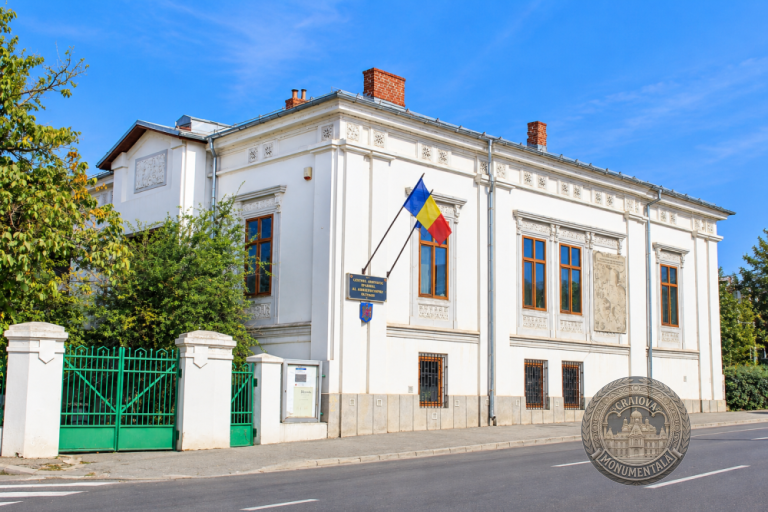
16 The Administrative Palace
If you want to understand at a glance what the Neo-Romanian style is, stop by Prefecture Square in Craiova. The Administrative Palace at 19 Calea Unirii is the city’s most iconic building and a textbook example of this style.
The building was designed by Petre Antonescu, one of the leading proponents of the Neo-Romanian style.
Construction began in 1907 and was completed in 1913.
The work was carried out by the Italian engineer Giovanni Battista Peressutti, a friend and schoolmate of Petre Antonescu.
The palace was built on three levels and had 106 rooms.
The building’s history mirrors that of the city.
In 1915, it housed the Museum of Antiquities and Ethnography of Oltenia, and between 1916 and 1919, during the German occupation, it served as the headquarters of the German Railway Administration.
On December 12, 1922, the Craiova Scientific Circle Society was founded on the premises of the Prefecture, under the direction of Professor Marin Demetrescu, with the aim of establishing a Natural History Museum in Craiova.
In 1934, the Regional Museum’s collections were moved to the basement rooms, and in September of that same year, the ceremonial hall hosted the proceedings of the second Congress of Archaeology and Numismatics in Craiova—an event so significant for the city that its anniversary was commemorated, decades later, with commemorative medals.
In 1935, a crack appeared during work on the dome of the grand staircase, and the reinforcement was carried out under the direct supervision of Petre Antonescu, the architect of the original project.
Today, the palace houses the Dolj County Prefecture and the Dolj County Council. The square in front, bordered by monumental buildings both old and new, is one of Craiova’s most beautiful urban spaces.
References
- Paul Rezeanu, „Craiova.The City’s Memory” (Alma Publishing, 2007)—an analysis of Petre Antonescu’s work in Oltenia.
Continue exploring
Other recommended locations
91 Casa Gabroveanu
Pe strada Iancu Jianu nr. 10, în apropierea Grădinii Botanice, se află Casa Gabroveanu, clădirea a fost construită...
View location