14 RAMURI Palace – Oltenia Museum – Natural Sciences Department
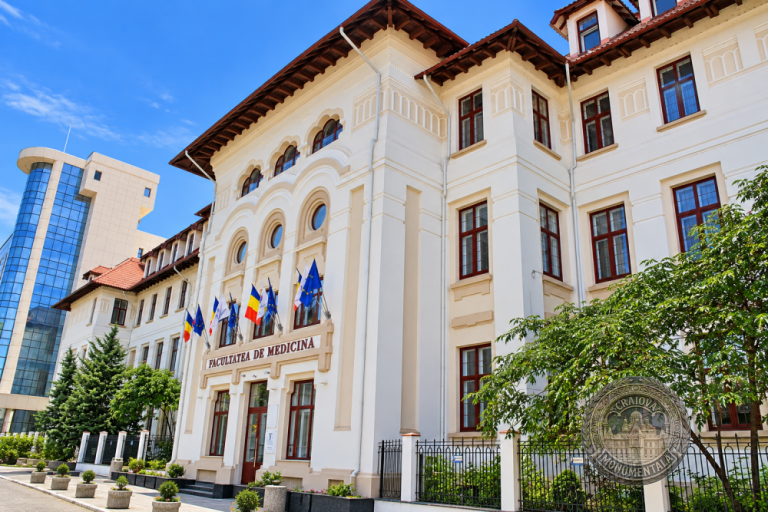
The Natural Sciences Department of the Oltenia Museum is housed in Ramuri Palace, located at 8 Popa Șapcă Street, in a historic building in downtown Craiova.
The history of the “Ramuri” Palace begins even before the building was constructed, with the launch of the literary magazine “Ramuri” on December 5, 1905, an initiative of the young men Constantin Șaban-Făgețel and Dumitru Tomescu.
In 1912, the two founders established the “Ramuri” Printing House, organized as a joint-stock company with an initial capital of 100,000 lei and headquartered at 5 Liceului Street.
By 1915, the company’s capital had reached 300,000 lei.
In 1920, the Board of Directors of the “Ramuri” Institute of Graphic Arts decided to construct its own building on the land previously occupied by the houses known as “Pomul Verde.”
The project was entrusted to architect Constantin Iotzu (1884–1962), one of the leading figures of Neo-Romanian architecture, and the construction work was carried out by the Italian builders Dalla Barba and Peressutti.
The building was erected between 1920 and 1927.
One of the most important figures associated with the “Ramuri” Palace is the historian, writer, and politician Nicolae Iorga (1871–1940).
Beginning in 1915, Iorga edited the magazine “Ramuri – Drum Drept,” which emerged from the merger of the two publications.
His association with the magazine continued until 1927, contributing to the institute’s cultural prestige.
The Oltenia Museum, to which this section belongs, was founded on April 1, 1915, under the name Museum of Ethnography and Antiquities of Oltenia.
The founder’s name is worth mentioning: Ștefan Ciuceanu, a history teacher at the “Carol I” High School, the man who rallied the passion and dedication of prominent Craiova families from the early 20th century around the idea of a museum.
Few Romanian cities can boast a museum that began with a single teacher and a few donors, without state support, and has grown into a heritage institution with four locations.
The Natural Sciences Section features collections of flora, fauna, and geology from Oltenia, with dioramas and educational materials that attract generations of students and researchers.
We’re talking here about a type of museum that, in European cities, has proven most effective for young audiences: not display cases with objects lined up in rows, but environmental reconstructions where visitors can see what a biotope, a food chain, or an extinct species actually looks like.
A child who enters such a hall doesn’t just read about the forest—they see the forest, with its animals, seasons, and light.
The building itself adds something special to the visit.
The Ramuri Palace is a historic structure, with understated elegance, and its name reflects its connection to the “Ramuri” publishing house and magazine, one of Craiova’s cultural institutions.
In other words, the museum’s theme and the atmosphere of the place go hand in hand: nature studied, exhibited, and recounted in an old house where books were once made.
References
- Otilia Gherghe Centennial of the Oltenia Museum 1915–2015
Continue exploring
Other recommended locations
2 The Jean Mihail Palace
Located at 15 Calea Unirii, it is, for many residents of Craiova, the most beautiful house in the...
View location