
37 Elena Farago House
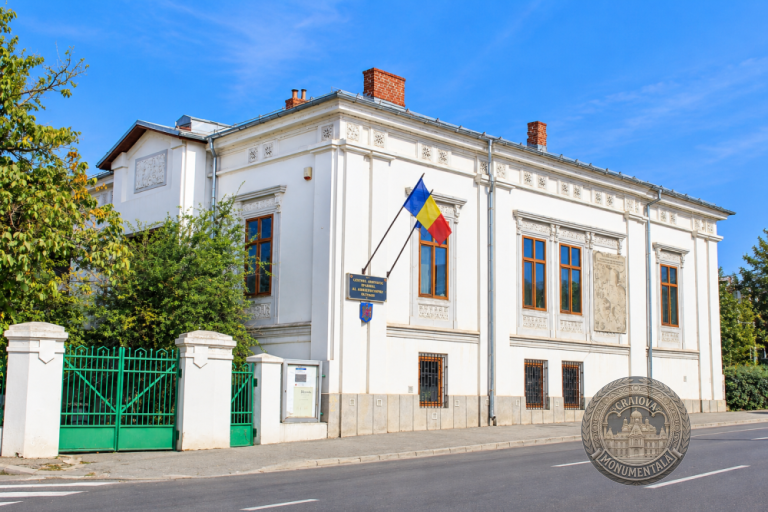
The “Elena Farago” Memorial House, located in the courtyard of the “Alexandru and Aristia Aman” County Library in Craiova, is one of the city’s most important sites of literary heritage. The building, constructed in 1898, is closely linked both to the generosity of the Aman family and to the life and work of the poet Elena Farago, who lived here for several decades.
The building was not originally built for the poet, but as a secondary residence for the staff employed by the Aman family.
On December 21, 1908, the “Alexandru and Aristia Aman” Foundation was officially inaugurated in the presence of Spiru Haret, Minister of Public Instruction and Religious Affairs.
The poet Elena Farago (1878–1954), born in Bârlad, settled in Craiova in 1907 with her husband, Francisc Farago. Before arriving in Oltenia, the poet had lived for a time in Bucharest, where she worked for the family of playwright Ion Luca Caragiale and became involved in the literary circles of the time. According to records preserved by the institution, the Farago family was housed in the home that would later become the poet’s official residence.
A pivotal moment in the building’s history occurred on September 1, 1921, when Elena Farago was appointed director of the “Alexandru and Aristia Aman” Foundation. From that moment on, the house became her permanent residence, and the poet continued to live there until her death in 1954.
The library began its operations with the Aman family’s books; subsequently, the collection grew through acquisitions and donations, the most significant of which was from former mayor Nicolae Romanescu.
Elena Farago is best known for her children’s poems, which have shaped entire generations: “The Lame Puppy,” “The Little Beetle,” “The Hen,” “The Fingers’ Advice,” and “The Punished Tomcat.”
The house houses a permanent exhibition featuring 396 items: pieces of furniture, personal belongings, books, and magazines, as well as hundreds of original documents, photocopies, family photographs, and correspondence.
References
- PAUL REZEANU Craiova.The city of a thousand millionaires
- Magda Buce Răduț The Past in Today’s Craiova
Continue exploring
Other recommended locations
63 Vrăbiescu House
Located at 100 Calea Unirii, next to the Calețeanu House, the Vrăbiescu House is a building dating back...
View location