30 Poenaru House
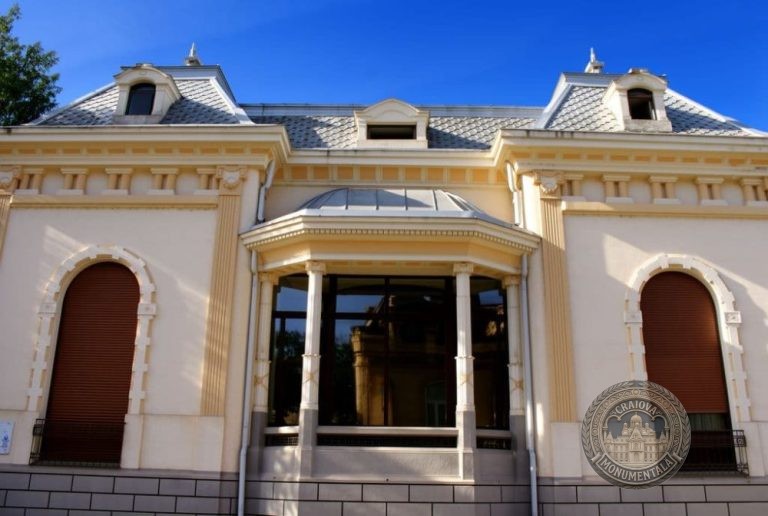
Located at 10 Eugeniu Carada Street is the Poenaru House, one of Craiova’s most spectacular historic residences. Built in the late 19th century, around 1890–1895, the house belonged to the family of Constantin Poenaru, a family that owned extensive landholdings.
The house was built by the Italian construction firm Adotti, and prominent architects of the era, including Ion Mincu, I. D. Berindei, and Duiliu Marcu, contributed to its design and construction.
The exterior combines influences of the late French Baroque with neoclassical elements, but the real surprise lies inside. There, the decor becomes much more opulent, with influences of the late Baroque and Rococo, creating an atmosphere characteristic of the grand, elegant residences of that era.
The exterior combines influences of the late French Baroque with neoclassical elements, but the real surprise lies inside. There, the decor becomes much more opulent, with influences of the late Baroque and Rococo, creating an atmosphere characteristic of the grand, elegant residences of that era.
One of the most spectacular spaces is the Grand Hall of Honor, from which a T-shaped marble staircase ascends. On either side are two large Venetian crystal mirrors, and the staircase leads to the Salon of Honor, from which the other rooms open through richly ornamented doors. These details show just how important it was to the owners of that era for a residence to impress not only with its façade, but also with the spaces you discovered once you crossed the threshold.
Today, the building is also known for the Student Cultural Center that once operated here.
While the house’s façade impresses with its elegance, the interior hides an even more spectacular detail: the two large Venetian crystal mirrors, placed on either side of the marble staircase in the Grand Hall of Honor. For a house built more than a century ago, such details demonstrate just how sophisticated the interior of a Craiova residence could be and how much effort was invested in creating an atmosphere of prestige.
Petrache Poenaru was born on January 10, 1799, in Benești, Vâlcea County, and died on October 2, 1875, in Bucharest. His connection to Craiova is close and well-documented: between 1811 and 1818, he attended secondary school at the school attached to the Obedeanu Church in Craiova, the same school that would later become the “Carol I” National College.
He was a student of Gheorghe Lazăr at the Saint Sava College in Bucharest, and later became a teacher himself, working alongside his mentor and serving as the school’s principal in 1832. He was one of the organizers of the Romanian national education system.
The inventor studied at the University and Polytechnic of Vienna—Greek, Latin, mathematics, and physics—between 1824 and 1825, then engineering—and in Paris, on May 25, 1827, he patented an invention he charmingly named “the endless portable pen, which feeds itself with ink,” in French “plume portable sans fin, qui s’alimente elle-même avec de l’encre.”
It was the world’s first reservoir pen. Its mechanism, designed to push ink toward the tip with a light squeeze of the barrel, would later lead to the invention of the piston. Poenaru, however, was unable to capitalize on his invention; it never went into mass production, and the title of inventor of the modern fountain pen is attributed to the American Lewis Edson Waterman.
He was at once a mathematician, physicist, engineer, educator, journalist, politician, and agronomist—a true Enlightenment figure in every sense of the word. He laid the foundations for the Philharmonic Society, the Botanical Garden, and the National Museum of Antiquities in Bucharest, and in 1848 he played an active role in the revolutionary events in Craiova, where he was appointed director of propaganda for Oltenia. He is also credited with designing Romania’s current tricolor flag.
Puțini oameni dintr-o singură generație au lăsat urme într-atâtea domenii.
Un detaliu care merită păstrat: ca tânăr, înainte de a-și lua soarta în mâini, a fost atras de viața haiducilor din mahalalele Craiovei.
Cei care l-au primit între ei au rămas uimiți să descopere că tânărul nu știa să folosească armele și că purta mereu după el o călimară — un viitor inventator aflat în toiul unei vieți de haiduc, cu „condeiul” în buzunar.
References
- Cătălin Bărboianu și Georgiana Fota Clădirile vechi din Craiova contemporană
Continue exploring
Other recommended locations
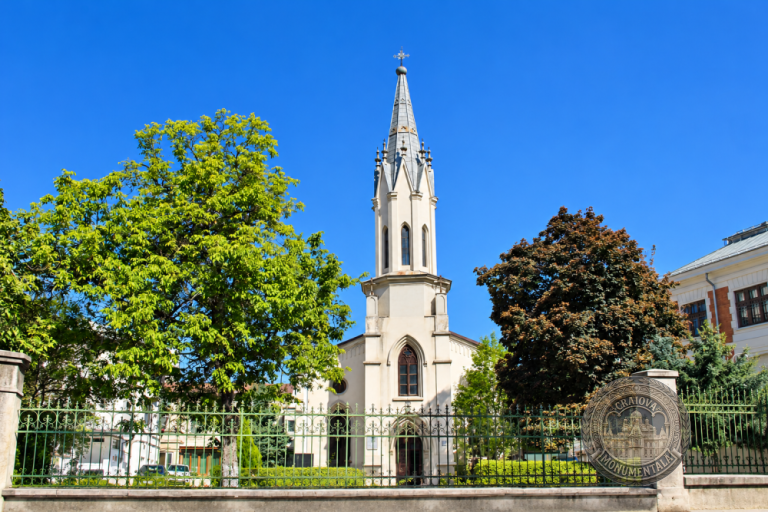
7 The Roman Catholic Church of “All Saints” – “St. Anthony”
The church is dedicated to “All Saints” (November 1) and “St. Anthony of Padua.” It is a historic...
View location